The Opposite of Perfectionism
The opposite of perfectionism includes various personality traits, decision-making styles, and psychological perspectives. I will refer to the opposite of perfectionism as anti-perfectionism, as I couldn’t find a better term.
Terms for the Opposite of Perfectionism
An imperfectionist is satisfied with imperfection and uninterested in perfection.
Satisficer stops searching after they find an option that is good enough, that meets their needs.
Other terms:
- Flexible – Someone who adapts easily and doesn’t need strict standards
- Realist – Someone who accepts practical limits rather than pursuing impossible ideals
- Easy-going – Someone who remains calm and unworried about imperfections
- Accepting – Someone who embraces themselves and situations as they are
- Pragmatist – Someone who accepts reality as it is, without striving for an ideal
- Completionist – Someone who focuses on finishing tasks rather than making them perfect
- Type B personality – Someone who is easygoing, accepting of imperfection, and focused on completion rather than flawlessness
- “laid-back,” “down-to-earth,” “practical”, “accommodating,” and “lenient”
As I said, I prefer anti-perfectionist.
Psychological Characteristics of Anti-Perfectionists
Anti-perfectionists prioritize the process rather than just focusing on the end result. They are comfortable with uncertainty and believe that “good enough” is not the enemy of perfection. They practice self-kindness and acknowledge that inner dialogue—often referred to as the monkey mind—is ever-present. However, they choose to respond thoughtfully rather than react.
Focus on the process rather than getting caught up in an imperfect future.
“Perfect is the enemy of good” -Voltaire
The Benefits of Anti-Perfectionism
Anti-perfectionists have higher life satisfaction, better mental health, greater creativity, and improved productivity.
The main concept of anti-perfectionism is that “good enough” truly is enough. Not laziness or a lack of standards; rather, recognize that perfection is unnecessary and counterproductive. Striving for excellence differs from insisting on perfection.
The opposite of perfectionism is acceptance of the moment.
The Dark Side of Anti-Perfectionism: When “Good Enough” Goes Too Far
Anti-perfectionism can have negative consequences when taken to extremes. Just as perfectionism exists on a spectrum from healthy to maladaptive, anti-perfectionism can also become excessive.
Beyond mere apathy or malaise, anti-perfectionism can lead to learned helplessness unless accompanied by a growth mindset. Signs such as procrastination, underachievement, isolation, and disconnection from one’s values indicate that perhaps you have gone to the dark side of anti-perfectionism.
Conclusion
The opposite of a perfectionist—an imperfectionist or satisficer— neither term I like —embraces flexibility, accepts “good enough” outcomes, and prioritizes progress over perfection. This leads to greater happiness, creativity, and overall well-being compared to those who relentlessly pursue their parents’ or someone else’s dream.
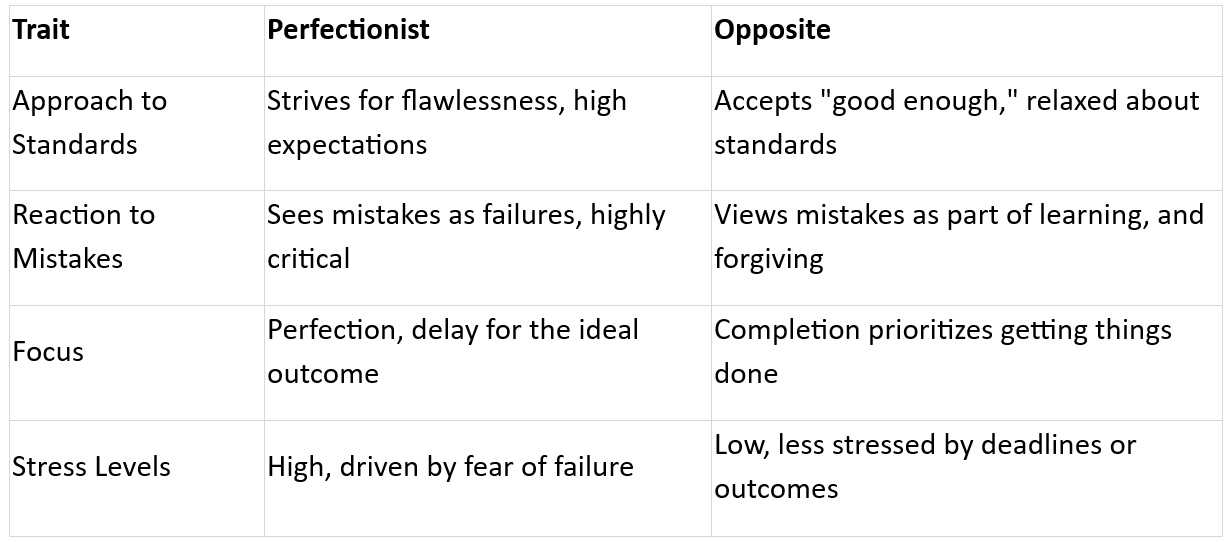
Be more relaxed about standards, prioritize getting things done rather than making them perfect, and be less critical of yourself or others. Laid-back, less stressed by deadlines, and accepting of “good enough” outcomes, I am an anti-perfectionist.